Plantar fasciitis and loading patterns
Plantar fasciitis isn't a foot problem. It's a report on how your whole body carries load, and what the bottom of your foot is paying for.
Plantar fasciitis isn't a diagnosis, it's a report
The name implies inflammation of the plantar fascia. That part is true, but it's the least useful part. What the name doesn't tell you is why that specific band of tissue, under your heel, is the place your body decided to fail. The fascia didn't choose to hurt. It reports the load that kept arriving at it, step after step, for months or years.
I see clients every week who have done everything the symptom demands. They've rested, iced, rolled a frozen water bottle under the arch, worn a night splint, bought better shoes, switched to zero-drop shoes, switched back, had two cortisone shots, tried a month of eccentric calf lowering, and taped the arch. Some of it helped for a week. None of it stuck.
It didn't stick because none of it changed the load.
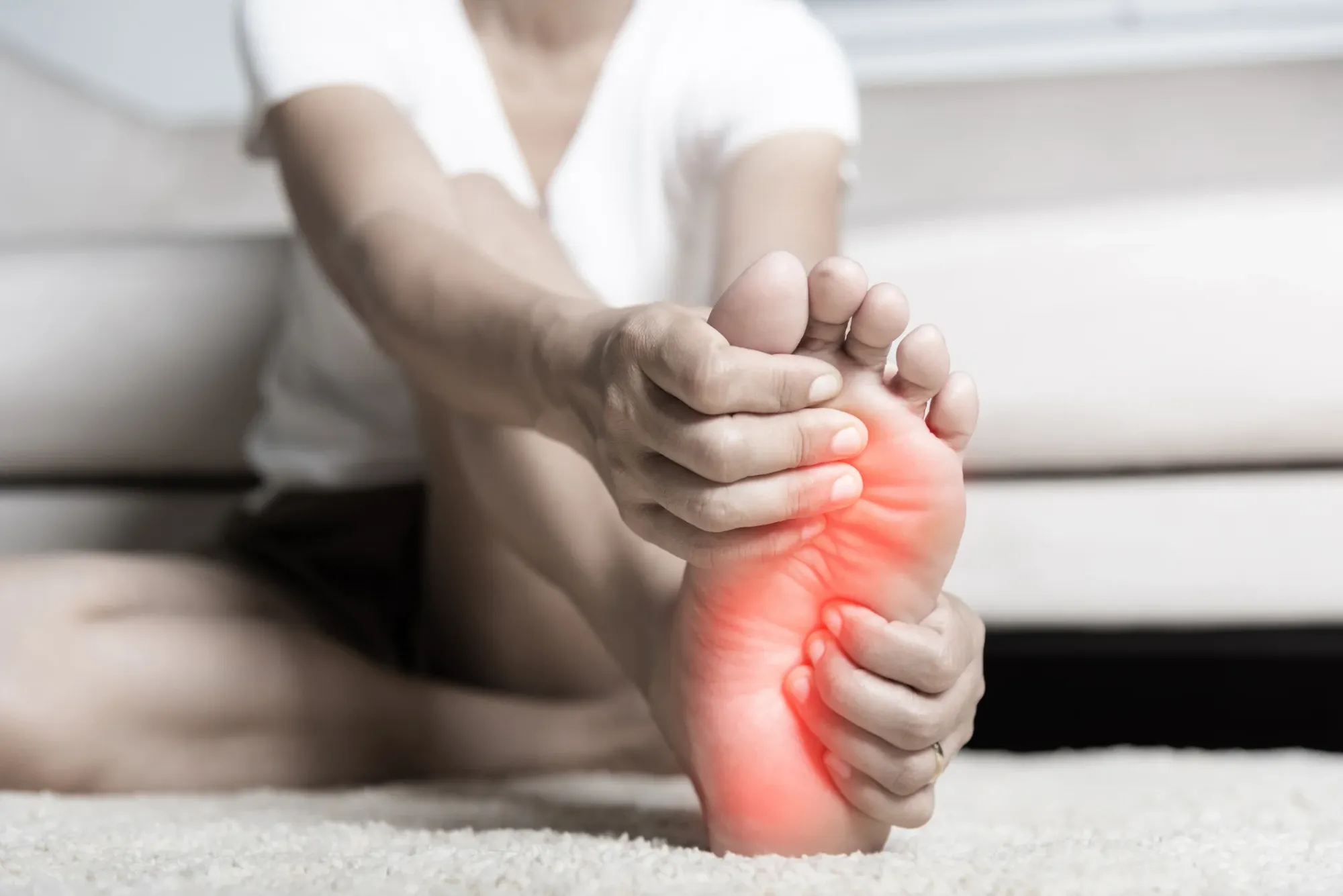
What loading actually means
Every step you take is a force transfer. The ground pushes back into your foot with roughly your body weight when you're walking, two to three times body weight when you're running. That force has to travel somewhere. It moves up through the foot, the ankle, the shin, the knee, the hip, and into the pelvis and spine. Whatever tissue is best prepared to absorb and redirect it does most of the work. Whatever tissue isn't prepared, or isn't available, gets skipped, and the next tissue in line picks up what the skipped joint didn't handle.
Loading is a distribution problem. The body is designed to share force across a lot of tissue. When joints move well and muscles fire at the right time, load lands in small pieces across a large system. When a joint stops contributing, the load that was supposed to disperse through it lands somewhere else, concentrated, repeatedly.
Plantar fasciitis is what it looks like when a narrow strip of fascia has been assigned more force than it was built to carry, thousands of times a day, for a long time.
The foot is the reporter, not the culprit
The foot is the last joint in the chain on the way up and the first one on the way down. It adapts to whatever is sitting above it. If your knee drops inward when you land, your arch collapses to meet the ground. If your hip doesn't extend behind you at the end of your stride, your calf has to lengthen harder to finish the step, and the plantar fascia is the tissue sharing that calf's work. If your ankle doesn't bend well, the forefoot absorbs the transition the ankle skipped.
That's why the foot is where you feel it. The foot is honest. It doesn't negotiate with the load. It tells you the truth about what your hip, knee, and ankle are and aren't doing.
The three loading failures that create plantar pain
Almost every case of stubborn plantar fasciitis I see comes back to one or more of these three. They tend to run together because they reinforce each other, but they're worth looking at one by one.
The hip that doesn't extend
Hip extension is the motion of the thigh moving behind the pelvis. It's what lets you push off the ground at the end of a stride. Most adults, especially anyone who spends hours a day in a chair, have lost it. The hip flexors have shortened, the glutes have gone quiet, and the pelvis tips forward. The thigh never travels behind the body the way it should.
When the hip can't extend, the calf takes over. The calf finishes the push the hip was supposed to start. That extra work falls on the gastrocnemius and soleus, both of which share a direct fascial continuity with the plantar fascia. More calf tension equals more plantar fascia tension. For life.
This is why I usually find the plantar fasciitis fix at the hip, not the foot.
The knee that doesn't track
When the knee collapses inward on landing, called valgus, the arch has to collapse with it. The foot pronates harder and longer than it should. Pronation itself isn't the problem. Pronation is how the foot absorbs impact. Over-pronation, sustained too long in the gait cycle, is the problem. It over-lengthens the plantar fascia on every step and asks it to absorb load it wasn't built to absorb.
Knee tracking isn't a knee problem either. It's usually a hip control problem, specifically the glute medius not firing on time to keep the femur aligned. You can strengthen the foot all you want. If the knee keeps collapsing over it, the arch will keep collapsing too.
The ankle that doesn't dorsiflex
Dorsiflexion is the ankle bending toward the shin. You need roughly ten degrees of it to walk cleanly and about twenty for running and squatting. Many people have five or less. The ankle gets stiff from tight calves, from wearing heeled shoes all day (including most sneakers), and from just not being asked to move through range.
A stiff ankle hands its job to whatever is next to it. On the way up, that's the knee and hip. On the way down, that's the foot. The mid-foot and arch get asked to bend in directions they weren't designed for, and the plantar fascia gets pulled.
Why stretching and orthotics don't make it stop
Stretching the calf or the arch is a conversation with the symptom. The tissue is short because the loading pattern made it useful to be short. The body isn't confused. It adapted. If you lengthen the tissue without changing the load, the load lengthens it back down within days. You're negotiating with a body that's already decided.
Orthotics do something similar. They prop up an arch the foot stopped holding up on its own. They can give real, welcome relief while the tissue is angry. They don't teach the foot to hold the arch again, and they don't unload the calf or restore hip extension. If you take them out, you're back to the original problem.
None of this is an argument against stretching or orthotics. They are useful tools for calming inflamed tissue while you do the actual work. They are not the actual work.
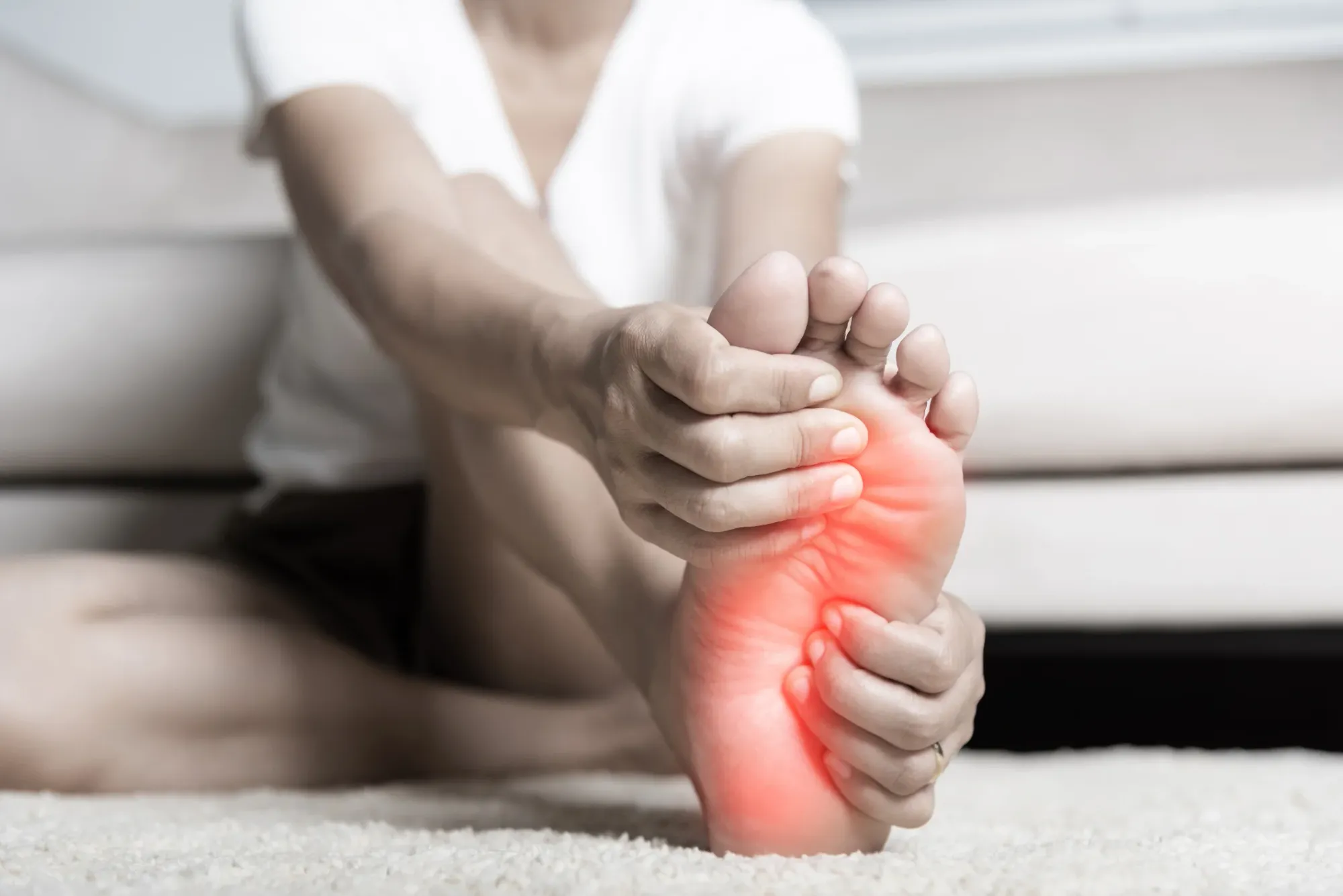
What a loading-based fix looks like
Three pieces of work happen at the same time, not in sequence. The fascia has to move, the quiet joints have to come back online, and the gait that overloaded the foot has to be relearned. Any one of them without the other two is a half-measure.
Work the Superficial Back Line as one piece of tissue
The plantar fascia sits at the bottom of a continuous fascial line that runs up the back of the calf, the hamstring, the lower back, the spinal erectors, and over the top of the head. It's called the Superficial Back Line, and it behaves like one long sheet of tissue because it effectively is one. Treating just the foot misses the point entirely. Releasing the hamstring and low back often takes more tension off the plantar fascia than working the foot directly does. Structural Integration gives me the access to work the whole line in the order it wants to be worked.
Reopen the hip, knee, and ankle so they share the load again
Hip extension comes back. Ankle dorsiflexion comes back. The glute medius learns to fire on time so the knee stops collapsing over the arch. None of this is exotic. It's careful, graded movement work, much of it passive in the beginning while the tissue is still sensitive, and most clients are surprised by how gentle the rebuild actually is.
Relearn the step itself
You've been loading the plantar fascia the same way for years, which means your nervous system has memorized that pattern as normal. Once the tissue is freer and the joints are available, I teach the step from the ground up. Where the foot strikes, how long the hip stays behind the body, how the glute carries you through push-off. People usually feel this shift within a few sessions. The step gets quieter. The ground feels different.
How long this usually takes
Loading patterns take years to build. They do not come off in a week. Most clients feel the first real change inside three or four sessions: less tender tissue, shorter morning pain, more standing tolerance. Resolution, meaning the pain is gone and stays gone without special shoes or a nightly stretching ritual, tends to land somewhere in the 12-session Structural Integration series, paired with movement work that carries forward after we're done. People who commit to changing how they walk stay fixed. People who just want the tissue released and then go back to the same gait usually need periodic tune-ups.
If you've had plantar fasciitis for years and nothing you've tried has held, the load never changed. That's the thing worth looking at.
Start here
The fastest way to see what your loading pattern actually is, as opposed to what a website says it might be, is a Body Systems Check. One appointment. I watch you stand, walk, and load one leg at a time, and you leave with a specific picture of where the force is going and why the foot has been carrying the bill. From there we decide together whether a full Structural Integration series andmovement coaching are the right fit, or whether something simpler will do it.
Questions, answered
How is this different from your main plantar fasciitis page?
The main page is for people who want to know what plantar fasciitis is and how I work with it. This page is for people who want to understand the mechanics. If you've already tried rest, orthotics, stretching, and shots and the pain keeps coming back, the loading pattern framing is probably why. Same condition, different lens.
Can I keep running or hiking while we work on this?
Most of the time, yes, with some modifications. Completely offloading the tissue rarely helps, because the plantar fascia needs load to remodel. What helps is changing how the load arrives. I usually cut mileage in half for the first few weeks, change where the foot strikes, and add single-leg work that rebuilds hip extension and ankle dorsiflexion. Most clients run better inside two months, not worse.
Will I still need my orthotics once the pain is gone?
Usually not. Orthotics prop up an arch that collapsed because the foot stopped doing its job. When the hip and ankle start carrying their share of the load again, the foot gets its job back. Some people keep a light insole for long days on hard floors. Most people eventually walk out of their orthotics entirely.
How is this different from physical therapy for plantar fasciitis?
Physical therapy tends to focus on the injured tissue: ice, eccentric calf loading, stretching the plantar fascia, sometimes dry needling. Those can be useful, and I send people to PTs I trust. My work starts further up the chain. I treat the fascial system as continuous, which means the back, hamstrings, calves, and arch are one line of tissue with one loading pattern. I work the whole line, then retrain the gait that was overloading the end of it.
The pain is only in one foot. Does that change anything?
It usually points to a rotational loading pattern. One hip moves differently from the other, one foot lands a little earlier, one ankle is stiffer. The asymmetry makes the diagnosis easier, not harder. I can usually find the source in the first session. One-sided pain also tends to respond a little faster than two-sided, because the other side is already showing us what normal looks like.
Why does it hurt the most in the morning?
Overnight, the tissue isn't loaded, so it shortens and dries out slightly. The first steps of the day ask it to lengthen fast. If it's already irritated and adapted to a short position, that stretch hurts. The morning pain fades through the day because the tissue warms and lengthens, not because it's healing. Lasting change comes from fixing the load it sees during the other twenty-three hours.