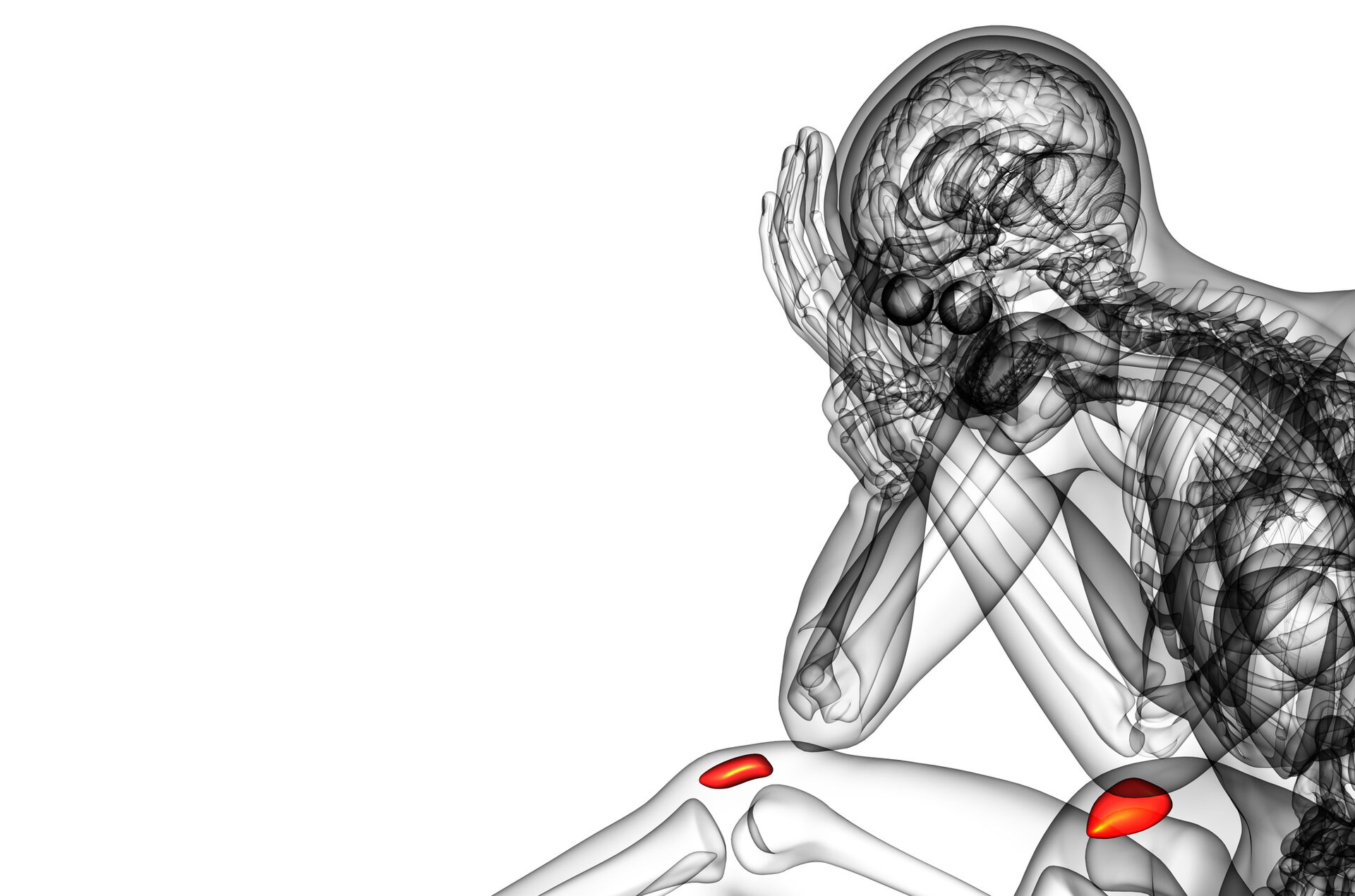
Technology is literally reshaping people's bodies. I see it every week on my table.
Someone comes in with shoulder pain, neck tension, or upper back stiffness. They're active, they exercise, they do everything "right." But their fascial system has reorganized itself around a laptop. The chest tissue is dense and shortened. The neck muscles are rigid. The upper back has given up, letting the shoulders roll forward into a permanent protective hunch.
Ten, twelve hours a day looking at screens. The body is not broken. It is adapting. And that is actually the problem.
Your Fascia is Listening to Your Laptop
You've probably heard that sitting is the new smoking. But the real issue isn't just that we sit. It's that we're teaching our bodies to be shaped by our technology.
Your fascia (the connective tissue webbing that wraps every muscle, bone, and organ in your body) is constantly remodeling itself based on how you move (or don't move). Think of it like memory foam, except instead of bouncing back when you stand up, it gradually becomes the shape you hold most often.
When you spend hours looking down at your phone, your fascia starts laying down extra fibers to support that position. Your chest tissues shorten and thicken. Your upper back muscles stretch and weaken. The fascia at the back of your neck gets dense and ropey trying to hold up your forward-tilted head.
And here's the kicker: your head weighs about 10-12 pounds in neutral position, but for every inch it moves forward, it effectively doubles in weight. Tilt your head down 60 degrees to check Instagram, and your neck is suddenly supporting 60 pounds of force.
Do that for hours every day, and your body says, "Okay, I guess this is who we are now." It reinforces the pattern. The fascia thickens. The muscles adapt. And suddenly "text neck" isn't just something that hurts when you text. It's how you're built.

The Whole-Body Conspiracy
But here's where it gets really interesting, and where my training under Tom Myers comes in.
Most people think pain happens in isolated body parts. Your neck hurts, so it must be a neck problem. Your shoulders are tight, so you need a shoulder massage. But fascia doesn't work that way.
Tom Myers mapped out what he calls "myofascial meridians," continuous lines of fascia that run throughout your entire body. There's a line that runs from the soles of your feet, up the backs of your legs, along your spine, over your skull, and down to your eyebrows. Another spirals around your body like a double helix. These aren't separate pieces. They're one continuous fabric.
So when you tilt your head forward to text, you're not just straining your neck. You're pulling on fascial lines that connect to your shoulders, your ribcage, your spine, your hips, even your feet. That's why my software engineer client had shoulder pain that started with his screen time. His forward head posture was yanking on the Superficial Back Line, the Spiral Line, and the Deep Front Line all at once.
This is why traditional ergonomics misses the point. You can have the perfect monitor height and the fanciest ergonomic chair, but if you're still static for eight hours a day, your fascial system is still adapting to immobility. You're still teaching your body to be furniture.
The $20 Billion Problem Nobody's Solving Right
Let's talk numbers for a second, because this isn't just about individual bodies. It's an epidemic.
- Musculoskeletal disorders cost employers $20+ billion per year
- Most computer users report pain somewhere in the body, with prevalence estimates ranging from about a third to over 90 percent across studies
- Extended sitting significantly harms even young, active adults, increasing cholesterol ratios and BMI after just 8 hours a day (and current exercise guidelines aren't enough to offset it)
- Too much sitting is linked to a 147% higher risk of cardiovascular disease and a 112% higher risk of diabetes
- Sitting can cause anxiety, depression, cancer risk, weak muscles, tight hips, bad backs, and even early death
And yet, what's the solution we keep hearing? "Sit up straight!" "Take breaks!" "Do some stretches!"
That's like telling someone to bail water out of a boat without fixing the hole.

What If We Designed Technology For Bodies, Not Screens?
I founded Rock Your Body because I got tired of watching people's bodies break down from tools that were supposed to make their lives easier. After ten years of movement education and four years studying structural integration under Tom Myers, I've spent hundreds of hours with my hands in people's fascia, feeling exactly how technology reshapes them.
And here's what I know: We're designing this backwards.
We're asking human bodies to adapt to rigid technology instead of creating adaptive technology that works with human bodies. We're treating ergonomics as an afterthought (a checklist item) instead of the foundation of design.
What if we flipped the script?
Design Principle #1: Movement, Not Position
The "perfect posture" is a myth. The best position for your body is the next position. We need technology that facilitates movement variability: interfaces that reward you for shifting positions, screens that prompt micro-breaks, devices that work whether you're sitting, standing, or lying down.
Your fascia needs variation like your lungs need air. Static loading (holding any position too long) creates adhesions and restrictions. Technology should be your movement coach, not your posture prison.
Design Principle #2: Work With Fascial Lines
When you understand the Anatomy Trains, you see that the body is an interconnected tensegrity system. Every movement affects multiple fascial lines simultaneously.
Good technology design would consider: How does this device position affect the Superficial Front Line? Is this interface forcing a pattern that shortens the Spiral Line? Does this workstation allow the Deep Front Line to function properly?
This isn't about perfect alignment charts. It's about understanding that when someone tilts their head forward, they're not just bending their neck. They're loading multiple whole-body fascial chains that extend from their skull to their toes.
Design Principle #3: Support Adaptation AND Learning
Here's something cool: your body can learn new patterns. Through movement re-education and fascial release, you can literally reorganize your connective tissue.
Smart technology could facilitate this. Imagine:
- Wearables that give you real-time biofeedback on postural patterns (not just "sit up straight" alerts, but nuanced information about how your fascial system is loading)
- Interfaces that incorporate therapeutic movement breaks based on fascial training principles
- Devices that progressively encourage healthier patterns as your body adapts, like a physical therapist built into your workstation
Design Principle #4: Recognize Individual Bodies
Not everybody's fascia is the same. Some people have more elastic tissue. Some have experienced trauma or injuries that changed their fascial architecture. Some have hypermobility; others have restriction.
One-size-fits-all ergonomics doesn't work because one-size-fits-all bodies don't exist. We need adaptive technology that learns your patterns and helps you develop healthier movement strategies.
Making the Complicated Relatable: You're Not Broken, You're Just Trained Wrong
Look, I get it. You read about fascia and myofascial meridians and connective tissue adaptation, and it sounds complicated. Academic. Maybe a little woo-woo.
But here's the simple version: Your body is always learning. Right now, your devices are teaching it to hurt.
Think about it this way. If you spent eight hours a day with your arm bent at 90 degrees, eventually you wouldn't be able to straighten it without pain. That's not because your arm is broken. It's because your fascia adapted to the position you demanded of it.
That's what's happening with your neck, your shoulders, your back. Your phone isn't breaking you. Your laptop isn't attacking you. But they're definitely teaching your fascia to be shaped in ways that cause pain, restrict movement, and create long-term structural problems.
The good news? Just like you can train your body to be dysfunctional, you can train it to be functional again. That software engineer I mentioned? After twelve sessions of structural integration work targeting his fascial lines, combined with movement re-education, his shoulder pain resolved. Not because I "fixed" his shoulders, but because we reorganized his entire fascial system to support healthy patterns.

The Future: Tech That Rocks Your Body (Instead of Breaking It)
I believe we're at an inflection point.
We've spent two decades designing increasingly sophisticated technology without considering the bodies that use it. And now we're seeing the consequences: an entire generation with text neck, chronic pain, postural dysfunction, and fascial systems organized around screens.
But it doesn't have to be this way.
What if tech companies hired movement specialists alongside engineers? What if product designers understood fascial continuities the way they understand user interfaces? What if we measured success not just by how many hours users engaged with our platforms, but by whether their bodies were healthier or more broken at the end of those hours?
This isn't about going backwards. I'm not anti-technology. I'm writing this on a laptop, and you're probably reading it on a screen. Technology is incredible. It connects us, empowers us, enables us to do things that would have been impossible a generation ago.
But we can do it better. We can create technology that doesn't require human bodies to contort themselves into rigid, pain-inducing patterns. We can design with fascial health in mind. We can build systems that support movement variability rather than static loading.
We can make technology that works with the human form instead of breaking it.
Your Body is Not the Problem
If you're reading this and thinking about your own neck pain, your tight shoulders, your aching back, I want you to know something: This is not your fault, and you are not broken.
Your body is doing exactly what bodies do. It's adapting to the demands you place on it. It's incredibly intelligent and remarkably resilient. The problem isn't you. It's that we've designed a technological ecosystem that demands positions and patterns that human bodies weren't built to sustain.
You can make changes right now:
- Bring your devices up to eye level instead of bringing your head down to them
- Build in micro-movements throughout your day (change positions every 15-20 minutes)
- Do fascial release work to restore glide to stuck tissues
- Work with someone who understands whole-body fascial patterns, not just isolated muscle groups
But more than anything, I want you to know that there's a better way forward. We don't have to accept that technology and body health are in conflict. We just need to start designing like we understand that bodies aren't accessories to our devices. Devices are tools for our bodies.
And bodies, when you work with them instead of against them, are capable of remarkable things.
This is the work I do at Rock Your Body: helping people reorganize their fascial systems and movement patterns after years of technology-induced adaptation. But my bigger vision is to bring this understanding into technology design itself. Because the best way to solve this problem isn't to address bodies after they break. It's to create technology that doesn't break them in the first place.
What would you want from technology that actually worked with your body? I'd love to hear what you're experiencing and what you wish existed.