Gym injuries from bad mechanics
When a gym injury happens, people describe the lift that caused it. The lift didn't cause it. The pattern you'd been running through that lift for months caused it, and the lift was the rep that finally cashed the check.
Injury one: the low-back tweak during a deadlift
The story is always the same. You were pulling what you'd pulled a hundred times. Maybe five pounds heavier than usual. Something in the low back felt like a snap or a hot wire. You couldn't finish the lift. You couldn't stand up straight for three days.
The lift didn't fail because the weight was too heavy. It failed because the hips stopped hinging somewhere between rep four and rep six. When the hips hinge, the lumbar spine stays neutral and the glutes produce most of the force. When the hips stop hinging and the spine starts flexing instead, the lumbar erector muscles and the posterior ligaments pick up the load the glutes refused. They can do this for a while. They can't do it indefinitely.
Upstream cause: hip flexor tightness or hip capsule restriction that prevents clean hinging under fatigue. Sitting culture is the usual source. The fix is addressing the hip tissue first, retraining the hinge pattern second, and getting back under load once the hinge holds at fatigue, not just at rep one.

Injury two: shoulder impingement from bench press
You've been benching for years. The front of your shoulder starts to ache. It gets worse over a month. Pressing overhead becomes painful. Reaching for a seatbelt irritates it. The orthopedist says impingement, maybe a small rotator cuff tear on imaging.
The bench press didn't do this. Your scapular pattern did. During a healthy press, the scapula retracts and depresses to create a stable base. The humeral head stays centered in the glenoid. The cuff and the serratus do their coordinating job. When any of that fails, the humeral head migrates upward during the press, compressing the tissue in the subacromial space. Every rep irritates it a little more.
Upstream cause: thoracic spine extension failure and scapular downward rotation from desk posture. The shoulder complex rests on the thoracic spine. If the thoracic spine has lost extension, the shoulder has to compensate by internally rotating, and the bench press happens on a compromised foundation. The fix is thoracic mobilization, lat and pec release, scapular patterning, and only then a graded return to pressing.
Injury three: the knee that started hurting mid-squat cycle
Your squats were fine for the first six weeks of the cycle. Somewhere around week eight, the right knee started aching after sessions. It got worse. Single-leg work hurt. Going down stairs hurt. You took a week off. Came back. Hurt again.
The squat didn't hurt your knee. The knee was paying for something that had been wrong before the cycle started and was now catching up. Almost always one of three things. The right ankle doesn't dorsiflex as well as the left, which sends the right knee forward at a weird angle. The right hip doesn't internally rotate as freely, which causes the knee to track inward to compensate. Or the right glute medius is quieter than the left, which lets the knee drift inward under load.
The knee is a hinge. It wasn't designed to absorb rotational or lateral forces. It's getting hit with those because the joints next to it aren't contributing. The fix is almost never at the knee. There's more detail on this pattern on theknee pain when squatting page.
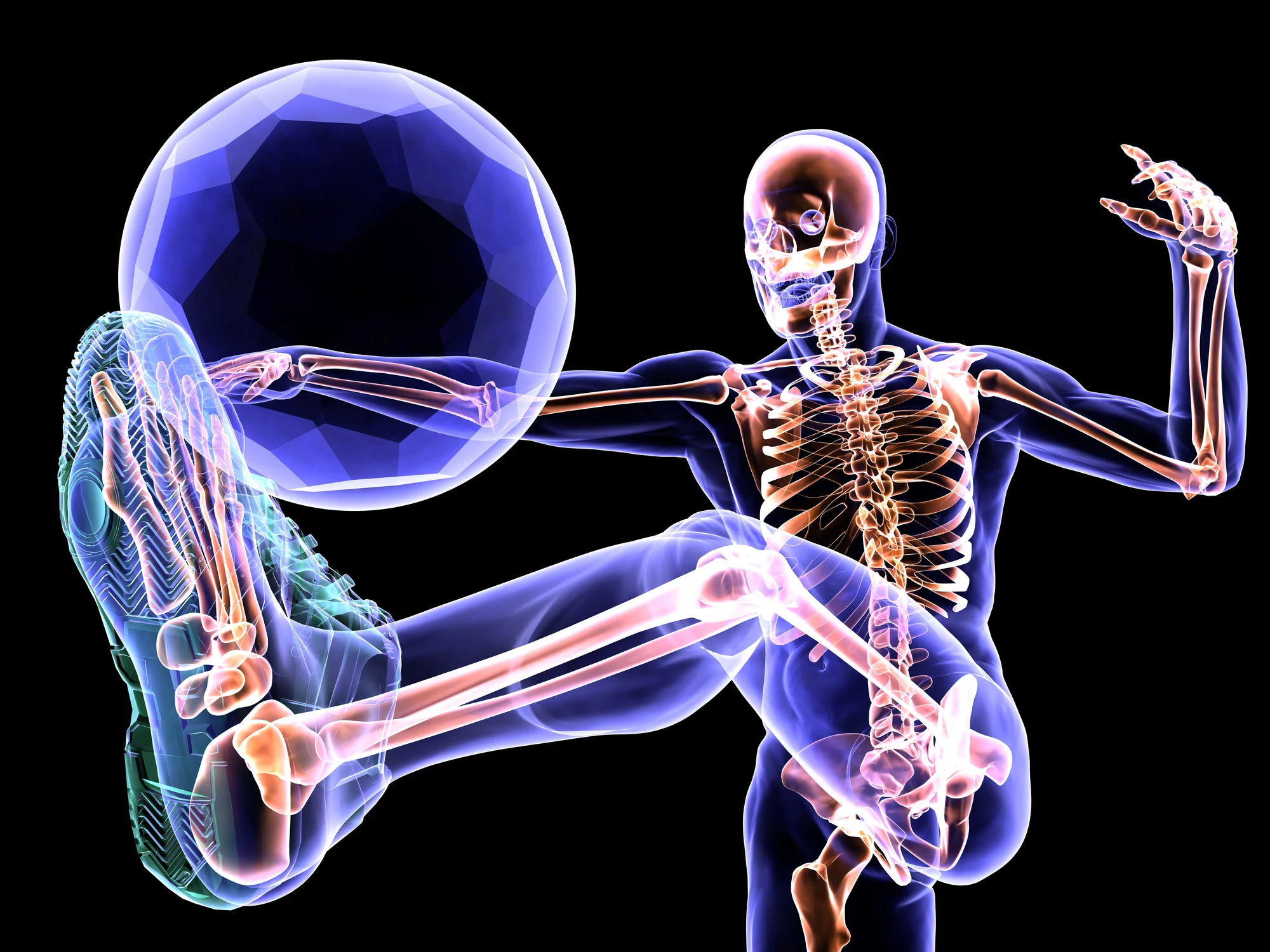
Injury four: the recurring hamstring pull in sprinting or deadlifting
This one's a classic. The hamstring is tight for months. You stretch it. It stays tight. Eventually it pulls. You rehab it. It pulls again three months later, in the same place.
The hamstring isn't tight because it's short. It's tight because it's doing hip extension alone, without the glute's help. The glute went quiet from sitting. The hamstring stayed on duty. Over time, the hamstring adapted to a shorter resting length because it was never allowed to fully relax, and under sprint loads or heavy pulls, the chronically-working, chronically-short tissue tears at the attachment.
Upstream cause: dormant glute max. No amount of hamstring stretching fixes this because the hamstring's tightness is a symptom of the real problem upstream. Glute activation, hip hinge patterning, and tissue work on the hamstring together resolve it. Stretching alone does not.
Injury five: the neck strain from overhead pressing
You added overhead press back into your program. A few weeks in, your neck gets tight. Then the upper traps get tight. Then you notice you've had a dull headache most days. The neck feels strained after every press session.
The press didn't strain your neck. Your breath did, compounded by a scapular pattern that wasn't ready for overhead work. Under a heavy overhead press, most people hold their breath and brace with their upper traps and neck extensors, because those are the only stabilizers they have access to. If the diaphragm isn't contributing to the brace and the serratus anterior isn't upwardly rotating the scapula, the upper traps do the whole job, and after a few sessions the neck starts broadcasting.
Upstream cause: shallow breath pattern plus scapular dyskinesis. The fix is breath retraining so the diaphragm participates in the brace, serratus activation, and progressive overhead loading once both are online.

The pattern under all five
Look at these together and the common theme is obvious. The tissue that's hurting is almost never the tissue that failed. The failure is one to three joints upstream, and the tissue at the injury site is absorbing the work the upstream joint stopped doing.
This is why rehab that focuses only on the injured tissue tends to recycle the injury. The calf strain that comes back. The shoulder that keeps getting irritated by the same movement. The low back that goes out every six months. In each case the downstream tissue is being asked to keep paying a bill that upstream can't settle, so the relief is temporary and the cycle continues.
Breaking the cycle means treating the upstream pattern, not the injury site. Fascial work along the whole chain, not just on the sore tissue. Motor retraining of the upstream joint's actual job, not just strengthening exercises for the area that hurts.
Read your own pattern
If one of these five sounds like the injury you keep running back into, the pattern behind it is almost certainly present and almost certainly addressable. ABody Systems Check is where we'd start. I watch you move, put hands on the tissue, and find the upstream joint doing the failing so you can stop chasing the downstream tissue that keeps taking the bill.
Questions, answered
Do I really need someone watching my form, or can I just film myself?
Filming from the side and front catches maybe sixty percent of what's going on. It doesn't catch what's happening inside the joint, in the breath, in the rib position, or in the way force is being distributed through tissue you can't see. For someone training at moderate loads with good baseline mechanics, filming is enough. For someone whose lifts are already producing pain, filming is insufficient, because what's wrong is below the surface the camera captures.
If my lift feels fine, does it mean my mechanics are fine?
Not necessarily. Pain is a late indicator. Tissue tolerates a surprising amount of abuse before it speaks up, and by the time it speaks, the pattern has often been running for months or years. The absence of pain means the tissue hasn't yet crossed the threshold where it protests. It doesn't mean the loading is ideal. Most of the lifters who come in with acute injuries describe the lift as feeling normal right up until it didn't.
I've been told my form is fine and I still get hurt. What else could it be?
Usually one of two things. Either the form looks fine in the plane being checked but is failing in a plane that isn't being checked, often breath, rib position, or the small stabilizers around the joint. Or the form is fine in isolation but the underlying fascial tissue is restricted enough that the movement requires a compensation the eye doesn't register. Both are reasons to look at the tissue, not just the form.
Can structural work actually prevent gym injuries?
It can materially reduce them by addressing the fascial patterns that make compensations the path of least resistance. If your thoracic spine rotates well, your shoulder doesn't have to make up for it on every press. If your hips extend cleanly, your lumbar spine doesn't have to pick up the slack during every deadlift. The injuries prevented are the ones you wouldn't know you had prevented, which makes the work feel unmeasurable, but over years the absence of specific chronic complaints is the evidence.