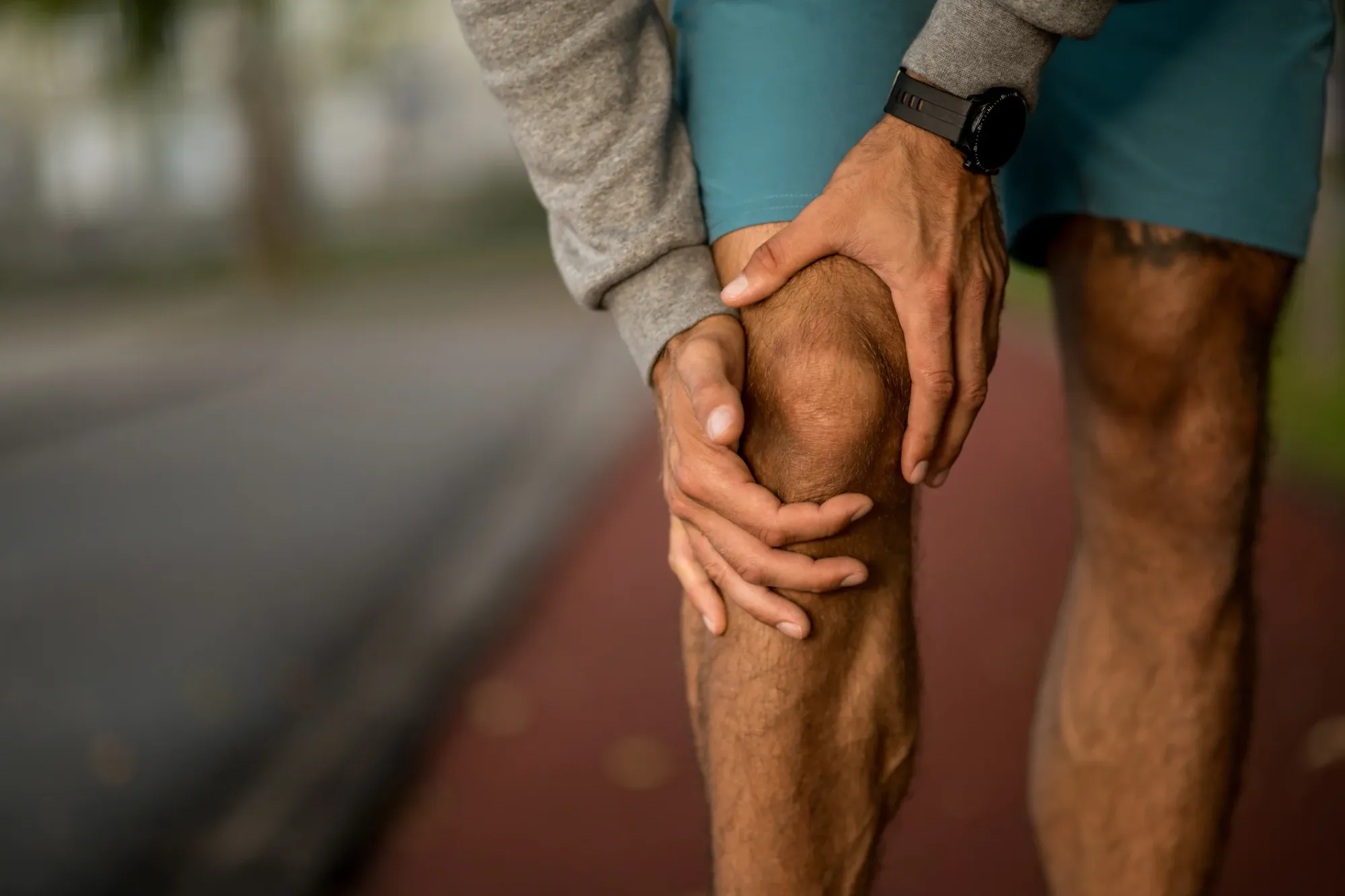
Knee pain when squatting
The squat is a four-phase movement. The knee only starts hurting after a joint further up or further down has already failed. This is what to look at, in order.
Phase one: the setup
Before you've moved, before gravity has done anything, the squat is already being won or lost at the feet and the rib cage.
The feet should be actively gripping the ground. Big toe down, heel down, outer edge anchored. Most people stand on passive feet, weight dumped into the medial arch, toes gripping in a fist because the arch gave up. That's a collapsed foundation, and the knee over it is already being asked to hold the alignment the foot isn't holding.
The rib cage should be stacked over the pelvis, not flared up and forward. A flared rib cage is a tell that the diaphragm is pulling up instead of down, which means you have no intra-abdominal pressure, which means your spine has no hydraulic support when load arrives. The knee ends up as the visible failure point. The actual failure was at the ribs.
I can tell within about fifteen seconds of watching someone stand whether their squat will hurt. Most of the work to make squats painless happens before the descent even starts.
Phase two: the descent
The descent is where most pain originates, even though pain usually fires on the way back up. What happens on the way down seeds the problem that triggers on the way up.
A clean descent is a coordinated drop between the hip and the ankle. The hip sits back, the ankle lets the shin translate forward over the foot, and the knee travels forward with the shin without caving in or drifting out. The spine stays neutral. The rib cage stays stacked.
The most common failure is an ankle that won't dorsiflex. If the shin can't tip forward, the knee can't travel forward, and the body has to find the range somewhere else. The usual fix, picked by the nervous system automatically, is to let the hip stop sitting back and let the torso fold forward. The spine takes over the job the ankle refused. The knee gets rammed forward anyway, just later and harder, once the hip runs out of room. That's the squat that feels "stuck" around the midpoint.
The second most common failure is knee valgus, the inward collapse of the knee as the hip descends. This is almost never a knee weakness. It's the glute medius, the muscle on the side of your pelvis that is supposed to hold the femur in line with the foot, not firing on time. When it doesn't fire, the knee falls inward, and the inside of the knee joint absorbs load it wasn't designed to absorb. Every rep.
Phase three: the bottom
If you can sit in the bottom of a squat comfortably, relaxed, for two minutes, you have earned enough hip, ankle, and spinal range to squat without hurting. Very few adults who grew up in chairs can do this.
What usually happens at the bottom is a small, invisible failure called butt wink. The pelvis runs out of hip flexion and tucks under, and the lumbar spine buckles into flexion under load. You don't see it on video unless you're looking for it. You feel it later as low back tightness and, often, as knee pain on the way up because the spine is no longer in position to transfer force to the hips, and the quads are doing it all alone.
Butt wink is a hip capsule and glute restriction, not a core weakness. You can plank until you're blue. The hips still won't let you into the bottom of the squat without tucking.
Phase four: the ascent
The ascent is where knee pain usually announces itself, and by then the cause is already in the rearview mirror.
A clean ascent is a reverse of the descent. The hip drives up and back, the ankle unwinds, the knee extends last. The glutes do most of the work. The quads participate but they don't lead.
A bad ascent is quad-dominant. The knees shoot up first, the hips lag, and the whole system is a knee extension with a torso hanging off the top. The kneecap takes the load the hip should have taken, and the patellofemoral joint gets angry over time. This is also where knee valgus reappears on heavy reps, because the fatigued glute medius releases and the femur rolls inward under load.
What actually fixes it
Knee pain when squatting is almost never a knee problem. It's the knee absorbing what the foot, ankle, hip, or rib cage didn't do. The fix is never at the knee itself.
Most clients I see for this need some combination of ankle mobility restoration (hands-on work on the calf and the ankle capsule), hip capsule work to reopen internal rotation and hip flexion, glute medius activation to stop the valgus collapse, and rib-cage-and-breath work so the torso has actual support. The hands-on component comes throughStructural Integration. The motor control and patterning comes through movement coaching. Together they change what the knee has to absorb.
You can film yourself squatting from the side and the front and see about half of what's going on. The other half is in the joint capsules and the neuromuscular timing, and that requires hands on and eyes watching in real time.
Get eyes on it
A Body Systems Check is a single appointment where I watch you squat, stand on one leg, and move through the patterns that tell me which joint failed first. You leave with a clear answer about where your knee pain is actually coming from and what the plan is to address it.
Questions, answered
Is squatting below parallel always bad for knees?
No. Deep squatting is fine for most humans and is how most humans have rested for most of history. The knee is built for it. What causes knee pain in the deep position is almost always a failure further up: not enough ankle dorsiflexion, a pelvis that can't posteriorly tilt at the bottom, or hip capsule tightness that forces the knee into a translation it wasn't designed for. Fix those, and deep squatting is not a knee problem. It's a capability the knee is waiting for permission to have.
Should I be squatting with my knees staying behind my toes?
No. That cue was popular in the 1980s and it's wrong for most bodies. Your knees absolutely travel forward in a healthy squat. What matters is whether the knee travels forward over the foot, or whether it caves inward, or whether the ankle refuses to let it travel at all so the lumbar spine picks up the slack. The forward-of-toes rule often creates more injuries than it prevents.
What about a knee sleeve or brace?
A sleeve can be useful. It adds proprioceptive input, warms the joint, and often reduces pain during the lift. None of that is fixing the loading pattern. If you find yourself needing the sleeve to squat without pain, that's a signal, not a solution. Use it short-term if it helps. Don't let it become permanent equipment while the underlying mechanics stay broken.
My pain is on the inside of my knee. Does the location matter?
Yes, it tells a story. Inside-knee pain usually points at valgus collapse, meaning the knee drops inward during the descent or the ascent. That's typically a hip control issue, specifically the glute medius not firing to hold the femur in place. Outside-knee pain more often points at hip tightness or IT band tension funneling load to the lateral compartment. Behind-the-knee pain usually means the hamstring or the joint capsule itself is compressed at the end range. Front-of-knee pain points at the quad-dominant pattern where the knee is translating forward faster than the hip is sitting back. Each of these changes what I work first.
Will you tell me to stop squatting?
Almost never. The squat is a foundational human pattern, and I want everyone to have access to it. What I'll change is what kind of squatting you do while we sort out the mechanics: shorter range for a while, tempo changes to build control at the transition, single-leg variations to expose and then rebuild the asymmetries. Most clients are squatting more by the end of the work than they were at the start, and without pain.