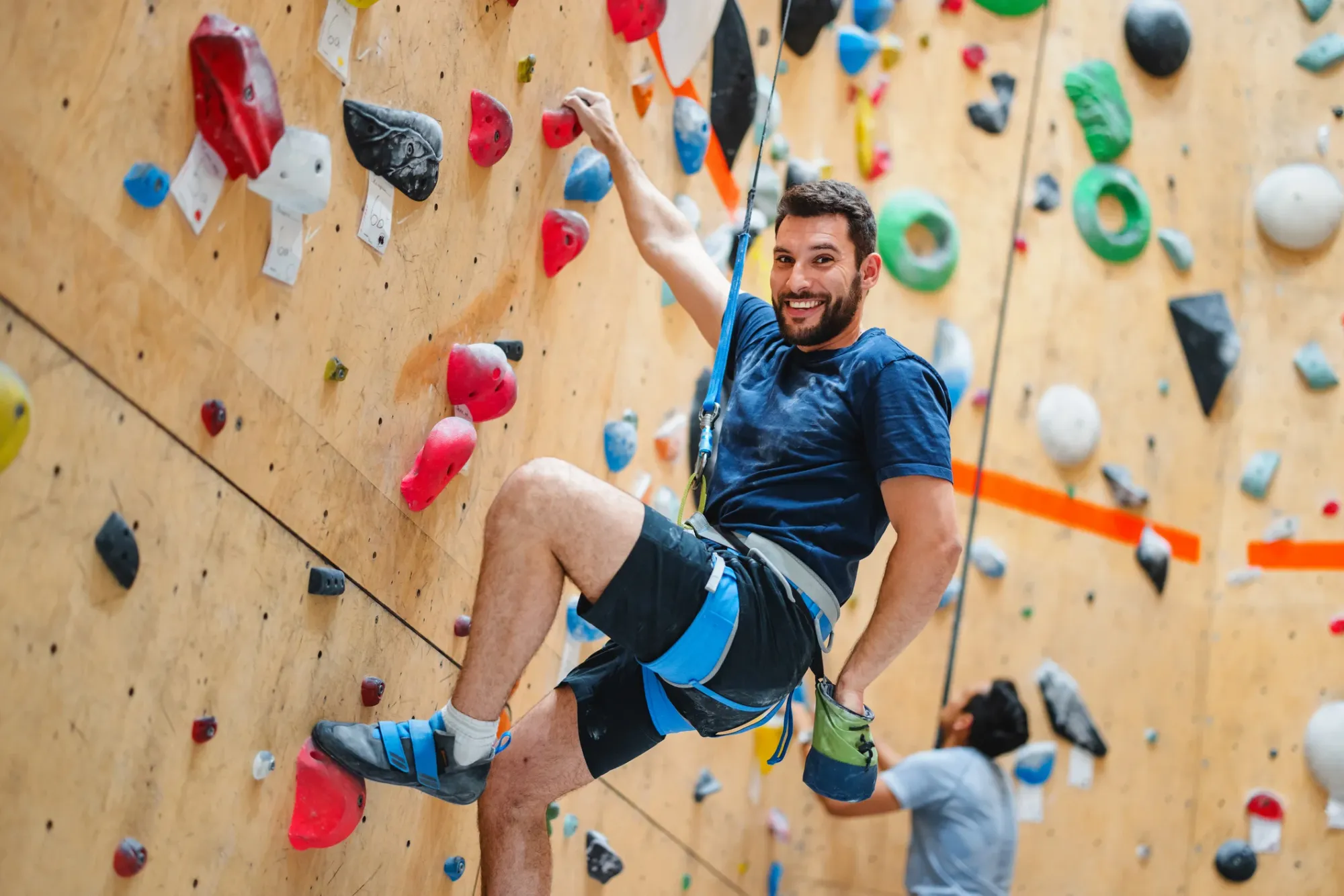
For climbers. The asymmetric sport.
Climbing is one of the most asymmetric sports the body has ever been asked to do. Pulling-dominant, overhead, grip-intensive, isometric. The body adapts beautifully. It also adapts in ways that eventually cost you.
What a climbing body becomes, if you let it.
Climbers build very specific bodies. Strong pulling musculature: lats, biceps, forearms, rear delts, mid-traps. Dense finger flexors. Capable core for tension. And, almost universally, a matching pattern of neglect: tight pecs and front delts, short lats, stiff thoracic spine from constant overhead reach, tight hip flexors from the folded positions, and underdeveloped pushing musculature.
This pattern is the climbing body. It's how you get strong at climbing. It's also the pattern that produces almost every chronic climbing injury. Climber's elbow, shoulder impingement, the A2 pulley pop, chronic neck tension, and lower-back pain on dynamic moves all trace back to this same silhouette. Not to any specific move. To the silhouette itself.
Why the fingers are the reporter, not the culprit.
When a pulley pops, climbers describe the move: a crimp that unexpectedly turned bad, a dyno that didn't stick, a foot that blew. The finger gets blamed because it's where the sensation arrived. The finger was asked to hold body weight with almost no warning and no help from the rest of the system. In a well-organized climbing body, the fingers are the last link in a chain of force, not the first. When the hip cuts, the core loses tension, the shoulder slips out of position, and suddenly all the force in a move lands on a distal tendon the size of a shoelace.
Fingers hold a lot. They don't hold emergency catch loads well. Most finger injuries are chain-failure injuries where the chain happened to bottom out at the finger.
This is the reason strong climbers still get hurt. It isn't insufficient finger strength. It's that the chain leading to the finger isn't reliably distributing load, so the finger periodically has to absorb a shock it wasn't built to absorb.
The four places climbers need honest attention.
In priority order, based on what I see most often in the office.
Hip mobility, especially rotation.
Climbers are strong at hip flexion under load, which is great for high steps. They almost universally lack hip extension and rotation. The heel hook wants external rotation. The flag and drop-knee want internal rotation. The high step wants extension in the opposite hip. Without these, climbers muscle up into positions they could have been placed into, which bleeds strength out of the fingers and shoulders for no reason. Fix the hips and the same moves get easier without getting stronger.
Thoracic rotation and extension.
The thoracic spine, your upper back, is the joint between your pulling shoulders and your stabilizing core. It should rotate and extend freely. Most climbers lose this by their thirties because they spend hours a day in forward-flexed climbing postures and then add desk work on top. When the thoracic spine stops moving, the shoulders have to absorb all the overhead reaching on their own, and the neck has to compensate for the rib cage that won't expand. Climber's shoulder and chronic neck tension both trace here.
Pec, lat, and subscapularis tone.
These are the tissues that pull the shoulder forward and internally rotated, which is the shape climbers spend hours in. Released, they let the shoulder settle into its socket, the scapula sit where it should, and the rotator cuff do its job. Unreleased, they're the background pull that eventually wins against the rotator cuff and sets up impingement, cuff tears, or the slow drift into bicep tendinopathy. Hands-on work here is more effective than stretching.
Antagonist loading.
The pulling-dominant sport needs deliberate pushing work to balance it. Push-ups, dumbbell presses, dips, scapular pushups, and external rotation work should be a fixed part of any serious climber's week. Most climbers do antagonist work in theory and skip it in practice because pulling is the fun part. The shoulder that gets worked evenly stays healthy for decades. The shoulder that gets pulled on without being pushed doesn't.
The climbing-specific injuries and what they're actually telling you.
Medial epicondylitis ("climber's elbow") is usually the pec and lat chronically pulling the shoulder forward, which keeps the forearm flexors slightly on all the time. The tendon at the inside of the elbow is where that chronic pull cashes the check. Fix the chest and lats, load the elbow tendon progressively, and it resolves. Skip the upstream work and it stays forever.
Shoulder impingement and bicep tendon irritation usually come from the thoracic spine not extending, the scapula not upwardly rotating, and the humeral head drifting forward in the socket. Treating the shoulder alone reaches maybe forty percent of the problem. The other sixty percent is upstream.
A2 pulley strains happen at the intersection of grip fatigue and chain failure. The interventions are taped rest for a stretch, graded loading to rebuild the pulley, and addressing the reason the finger took an unplanned load. That last piece is the one that determines whether it happens again.
For Santa Cruz climbers specifically.
The local terrain is generous. The Cave and the gyms are high-volume indoor options that let you train consistently regardless of weather. Castle Rock, Pinnacles, and the larger drive up to Yosemite give you real rock most weekends, and the tendon and shoulder demands of outdoor granite and sandstone are different from plastic. Many local climbers over-train indoors and are surprised when a weekend of real climbing exposes patterns the plastic had been quietly compensating for.
The work I do with climbers addresses the fascial pattern that climbing has laid down across years, restores the ranges that the sport systematically neglects, and leaves you with specific antagonist and mobility work to keep the body ahead of the sport rather than chasing it.
Start with what's actually tight.
If something in your climbing has been bothering you for months, a Body Systems Check will sort out whether it's local tissue, an upstream chain failure, or a training-load issue that doesn't need hands at all. Ninety minutes, honest read, and a plan.
Questions, answered.
My fingers are the limiting factor. Should I hangboard more?
+
Almost never. The answer is hang less for a while, eat more protein, sleep more, and work on shoulder and hip stability so your fingers aren't doing emergency load-bearing for joints that bailed. Hangboarding builds finger strength, which most serious climbers already have. What breaks pulleys isn't strength. It's sharp unplanned loads when the rest of the chain failed and the finger had to catch the whole body. Fix the chain and hangboarding becomes useful again.
I have climber's elbow. How long does it actually take to heal?
+
Medial epicondylitis typically takes three to six months to fully resolve, and that's with the right intervention. Eccentric forearm loading, sometimes progressively under PT supervision, is the best-evidence treatment. What accelerates it is releasing the tissue of the forearm, biceps, and pec that's been contributing to the pull on the tendon, and loading the elbow progressively rather than resting it into atrophy. What slows it down is continuing to project hard routes while it's inflamed. There's no fast fix, but there's a right sequence.
I'm a boulderer in my forties. Am I just going to be broken forever?
+
No, but you have to train differently than you did at twenty-five. Tendons at forty recover more slowly from the sharp load bouldering applies, which is why masters boulderers start climbing fewer total sessions but with better recovery between them. Antagonist work becomes non-optional. Warm-ups get longer. Route choice starts excluding the gimmicky stuff that asks for freak loading. Done that way, plenty of people are bouldering harder in their fifties than they did in their thirties.
What's the single highest-leverage thing I can add to my training?
+
For most climbers I see, it's hip mobility work, especially internal and external rotation. Climbers grind their grip and their pulling strength. They systematically neglect the hip, which is the joint that produces the heel hook, the high step, the drop-knee, the flag. A more mobile hip distributes load away from the fingers and shoulders on every move. The climbers who add serious hip work tend to climb harder within a few months, not just hurt less.