What is actually happening to your shoulders
Mountain biking loads the upper body in a way that is easy to miss because none of it feels dramatic in the moment. You are not lifting anything heavy. You are doing something more insidious: holding sustained grip, absorbing trail vibration, and bracing your arms against the bars for hours, often on terrain that keeps you ready to crash at any second. The shoulder is where all of that quietly collects.
Three forces drive it:
- Vibration. Rough trail sends constant low-grade shock up through the bars, the hands, and the arms. The tissue along that path stays braced against it the entire ride, and bracing for hours is its own kind of load.
- Sustained grip. Holding the bars fires the forearm and the arm line continuously. That tension does not stop at the elbow. It runs up the front of the shoulder and pulls on everything connected to it.
- The crash-brace pattern. On technical descents your body lives in a half-braced state, ready to absorb impact. That pattern shortens the front of the shoulder and locks the upper back into a defensive, rounded position that does not let go when you get off the bike.
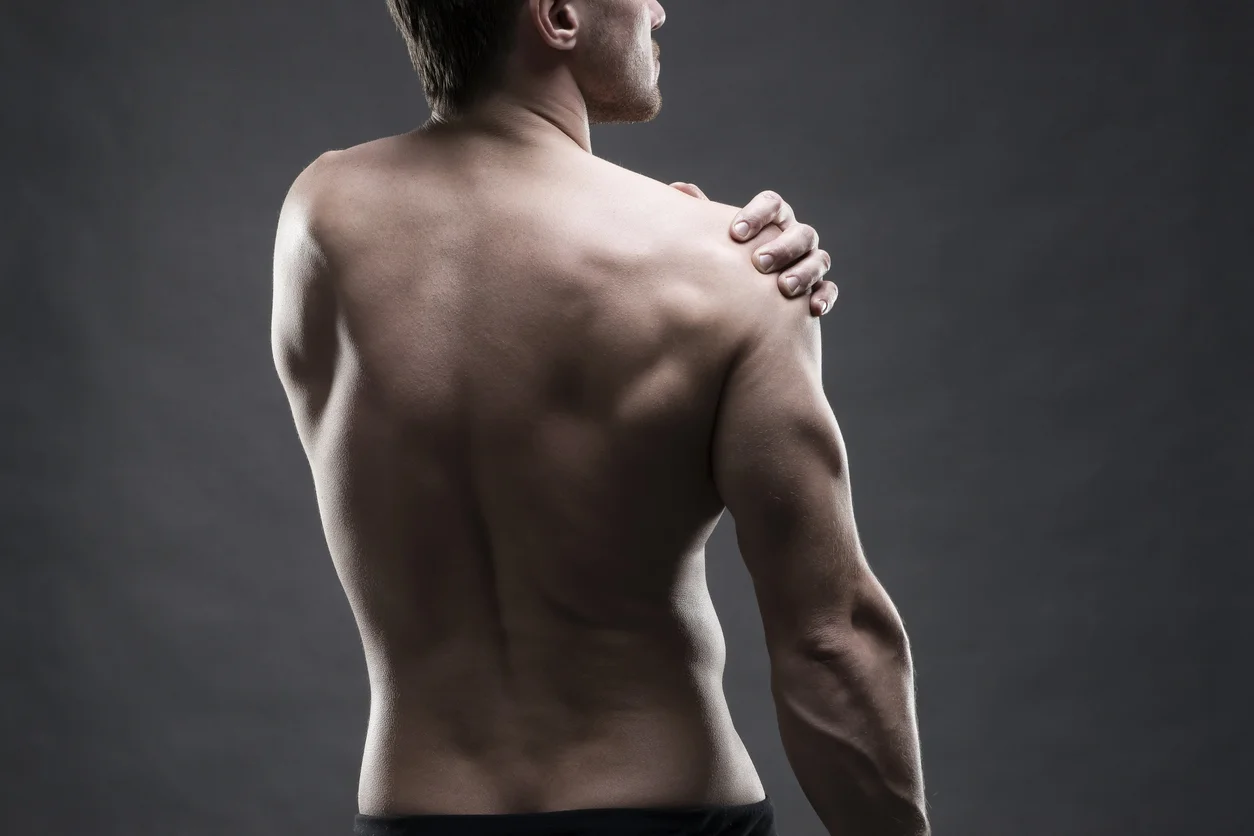
Why the arm line and the thorax are the real story
Your shoulder is not an isolated joint. It is the midpoint of a fascial chain that runs from your hand, up the forearm, across the front of the shoulder, and into the ribcage and mid-back. Anatomy Trains calls these the arm lines, and they connect your grip directly to your thorax. When you grip and brace for hours, that whole line shortens and loads as a unit.
Here is why that matters. If the thorax is stiff from the riding posture, the shoulder has to make up the movement the mid-back is not giving. The arm line is already short from the grip, the thorax is locked from the brace, and the shoulder sits in the middle absorbing both. That is the pattern that aches after a ride and flares on long descents. It is a system problem, not a single sore muscle.
Why a stronger rotator cuff does not fix it
The standard advice is to strengthen the rotator cuff. For most riders that misses the point. The cuff is the end of the chain, not the cause of the problem. If the arm line is loaded and the thorax is stiff, the cuff is already doing more than its share. Adding strength to a part that is overworked, while the rest of the chain stays short and stuck, does not relieve it. Sometimes it makes it worse.
Strengthening assumes the limit is weakness. The limit here is a restricted, loaded chain. You cannot strengthen your way out of tissue that needs to be freed. The structure has to change first.

The path: free the chain, then support it
This is bodywork-led. With hands-on structural integration, I work the whole arm line, from the forearm and the front of the shoulder into the ribcage, and I free the thorax so the mid-back extends and rotates again. When the chain lets go and the thorax moves, the shoulder stops being the part that absorbs the whole ride. That is the change that actually holds, because it addresses where the load is collecting instead of just hardening the spot that hurts.
Once the structure is freed, a little coached movement keeps it. I teach the upper back to stay mobile and the shoulder to organize well under grip, so the brace pattern does not creep straight back in. For riders who want to reorganize the whole pattern rather than chase the shoulder alone, the full 12-session series works the arm lines and the thorax as part of the entire structure. A focused flare can take far less. The mountain bikers page covers how this fits the rest of the riding body.
Where this fits in your recovery stack
- Massage releases tension locally. Useful after a hard ride.
- PT rehabs a specific injury. Useful when something is acutely wrong with the joint.
- Chiropractic adjusts joints. Useful for joint-by-joint complaints.
- Structural integration reorganizes the arm line and thorax so the shoulder stops getting overloaded in the first place.
It is not better. It is different. Most riders I work with use more than one of these, and the structural work is what changes the pattern underneath.

Why work with me
Most people who treat rider shoulder pain do one thing. A bodyworker frees tissue. A trainer builds strength. I do both, and that is the difference. I am certified in Anatomy Trains Structural Integration with more than 750 hours of training, I am a teacher-in-training under Tom Myers, and I am a NASM certified personal trainer and corrective exercise specialist. I have spent time in the dissection lab learning how fascia actually connects, so the map I work from is the real one.
That means I can reorganize your structure with hands-on work and then teach your body to hold the change with coached movement. Studio in Santa Cruz, mobile sessions across the Bay Area. Direct, honest, and built around what your body actually needs instead of a template.
Get the load off your shoulders
If your shoulders and upper back pay for every ride, the answer is not another cuff exercise. It is freeing the chain that is actually overloaded. I will tell you straight whether I can help.
Questions, answered
Why do my shoulders ache after a ride when nothing felt wrong on the bike?
Because the load is constant and low-grade rather than a single bad moment. Sustained grip, trail vibration, and bracing for impact keep the muscles from your hand to your ribcage working the whole ride. The ache shows up after because the tissue along that whole line has been quietly loaded for hours, not because you tweaked one joint.
I have been doing rotator cuff exercises and it has not helped. Why?
Because the cuff is usually not the source. It is the end of a chain that runs from your grip up through the forearm, across the front of the shoulder, and into the thorax. If that whole line is short and loaded, strengthening the cuff just adds work to a part that is already overworked. You have to free the chain first.
Is this rotator cuff damage I should worry about?
Worth ruling out with a physician if you have sharp pain, weakness lifting your arm, or pain that wakes you at night. A lot of rider shoulder pain is not a torn cuff. It is a loaded arm line and a stiff thorax overworking the shoulder. I will tell you honestly if what I see looks like it needs a medical workup before hands-on work makes sense.
Does the work address the upper back too, or just the shoulder?
Both, because they are the same problem. The arm line plugs straight into the ribcage and mid-back. I work the whole connection from the hand to the spine, not just the spot that hurts.
Will I have to stop riding while we work on this?
No. Most riders keep riding through the work. We time the deeper sessions so you are not heading out for a long descent the day after a heavy one.
How many sessions before it feels different?
A specific flare often eases in three or four sessions. The pattern that keeps producing it takes longer. The full 12-session series reorganizes the whole arm-and-thorax relationship so the shoulder stops being the part that absorbs the ride.